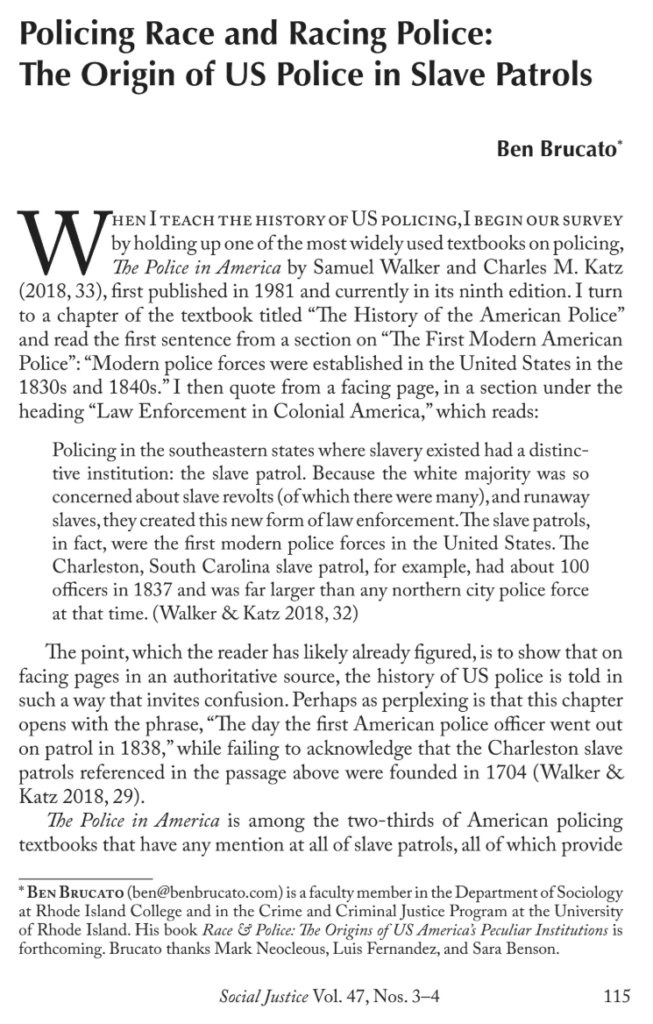
Policing Race and Racing Police: The Origin of US Police in Slave Patrols
Social Justice, 2020, Vol. 47 (3/4): 115-473
This article examines how race and policing are mutually constitutive, arguing that police power does not merely enforce a preexisting racial order but actively produces racial categories, meanings, and hierarchies. Rather than treating race as an pre-existing or an external influence on policing, the article centers policing itself as a formative institution in racialization, showing how the production of racial order is built into the everyday exercise of police power.
The analysis is grounded in historical research on policing in the colonial period, tracing how early police mandates emerged in tandem with the consolidation of racialized social relations. Drawing on historiographic work on colonial governance, the article shows how policing developed as a mechanism for organizing labor, mobility, and social order through racial distinction.
Building on and extending Mark Neocleous’s account of police power as the production of social order, the article argues that racial reproduction is central to policing’s mandate rather than a contingent outcome of bias or institutional failure. By situating policing within its colonial and racial origins, the article demonstrates how police practices continue to reproduce racial hierarchy as part of their core function.