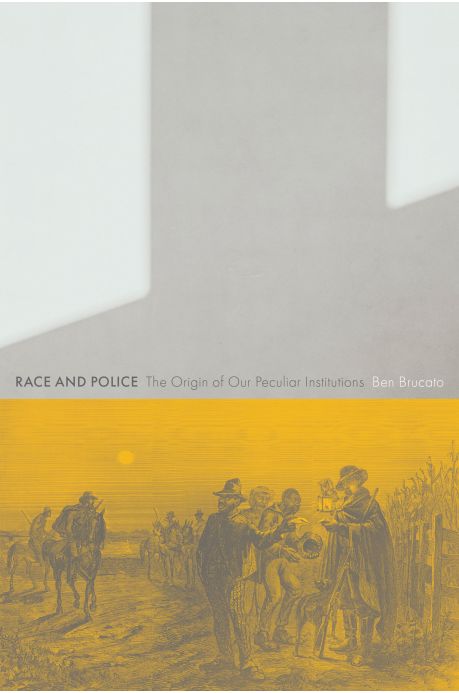
Race & Police: The Origins of Our Peculiar Institutions
Race & Police develops a critical theory of American policing by tracing its origins to slavery and slave patrols in British colonial America. The book shows that policing, race, and citizenship emerged together within a capitalist system dependent on enslaved labor. As racialized chattel slavery took shape, a binary conception of race was produced: Europeans were consolidated into a single category of whiteness tied to citizenship, while Blacks were cast as social enemies and threats to the social order.
Slave patrols did more than maintain order. They actively produced a racial order. White citizens were conscripted to police Black people, giving concrete meaning to whiteness, while the coercive regulation of enslaved people defined Blackness as a unified racial category. In this process, slavery, policing, and citizenship mutually constituted one another, producing racial capitalism and a working class divided by the color line—an arrangement whose logics continue to shape policing today.
New posts
-
Interview on KPFA “Against the Grain”
Back in 2021, I did an interview with “Against the Grain” on KPFA. I discussed my article, “Policing Race and Racing Police,” and the book I was working on at the time, later published as Race & Police in 2023 by Rutgers University Press.
Articles
-
The New Transparency
This article examines the contemporary belief that recording police violence promotes accountability, situating it in the long liberal tradition that treats transparency as a democratic good. Drawing on political theory, media studies, and research on police accountability activism, it shows how widespread civilian participation in surveillance persists despite clear evidence that visibility rarely produces accountability or reform, revealing transparency as a resilient political faith rather than an effective mechanism of change.
-

Policing Made Visible
This article analyzes competing claims about policing’s “new visibility,” showing that while both police accountability activists and police institutions frame on-officer cameras as tools of accountability grounded in mechanical objectivity, these systems ultimately function as counter-sousveillance technologies that privilege police perspectives and neutralize third-party documentation.
-
Policing Race and Racing Police
This article examines how race and policing are mutually constitutive, showing how police practices not only enforce racial order but actively produce racial categories and meanings. By analyzing the racialization of police work and the policing of race as a social process, the article situates racial reproduction as central to policing’s mandate, extending and updating Neocleous’s account of police power as the production of social order.
-
Fabricating the Color Line in a White Democracy
This article argues that U.S. policing is best understood as a central institution of white democracy: a project that produces social order by maintaining the color line through the administration of poverty and the recognition and denial of citizenship on the basis of race. It traces policing’s roots in slave patrols and fugitive-slave enforcement, then explains the persistence of racist outcomes in the officially color-blind era through the discretionary power of officers as “petty sovereigns.”