The New Transparency: Police Violence in the Context of Ubiquitous Surveillance
Media & Communication, 2015, Vol. 3 (3): 39-55
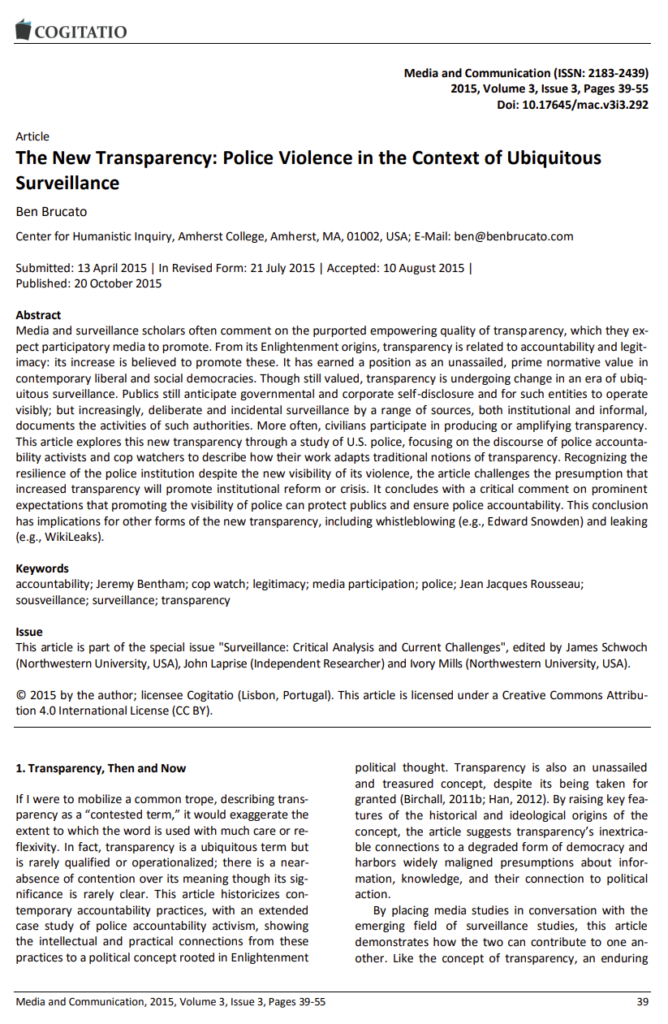
This article critically examines the widespread belief that making state violence visible will naturally lead to accountability, reform, or crisis for powerful institutions. Focusing on U.S. policing, the article traces the historical roots of transparency to Enlightenment political theory, where visibility was tied to legitimacy and accountability. It then shows how this ideal has been transformed under contemporary conditions of mass surveillance and participatory media.
Drawing on surveillance studies, media theory, and a detailed case study of police accountability activism and “cop watching,” the article argues that transparency has shifted from institutional self-disclosure to civilian-led documentation. Cameras are widely treated as neutral, objective witnesses, and visibility itself is often assumed to be politically empowering. Activists and commentators frequently claim that filming police violence will deter abuse, produce accountability, or delegitimize policing as an institution.
The article challenges these assumptions. Despite unprecedented levels of documentation, police violence persists, prosecutions remain rare, and institutional practices show remarkable resilience. Visibility, the article argues, does not automatically produce accountability. Instead, transparency increasingly functions as a substitute for structural reform, offering publics more images rather than meaningful political power. In this sense, transparency becomes a stabilizing force, absorbing outrage while leaving underlying relations intact.
By situating police surveillance alongside whistleblowing, leaking, and other forms of contemporary transparency politics, the article offers a broader warning: visibility alone cannot resolve deeply embedded power relations. Understanding transparency as a political ritual rather than a guarantee of change is essential for confronting state violence under conditions of ubiquitous surveillance.